How Appalachian Mountains Built a Gulf Coast Barrier Island
Most tropical and subtropical beaches in Florida and the Caribbean are biological in origin: waves crush mollusk shells, coral skeletons, and calcareous algae into calcium carbonate sand. Calcium carbonate grains are porous, darker in tone, and retain heat under direct sunlight.
Siesta Key is a geological anomaly. During glacial and interglacial erosion cycles over millions of years, granite and metamorphic rocks in the southern Appalachian Mountains weathered down, releasing resilient quartz crystals. The Apalachicola and Savannah river systems carried those quartz sediments southward to the coast, and longshore drift currents gradually transported the finest grains down the Florida peninsula onto the shallow continental shelf off Sarasota.
Because quartz has a Mohs hardness of 7, the grains resisted chemical dissolution while waves ground them into uniform, talcum-fine particles. The resulting surface acts like a mirror against solar radiation, keeping the top layer remarkably cool even when air temperatures exceed 90°F.
Comparing Siesta Key’s Three Distinct BeachZones
Siesta Key stretches roughly eight miles from Big Sarasota Pass in the north to Midnight Pass in the south, divided into three distinct coastal zones with very different parking and wave conditions:
1. Siesta Beach (Main Public Pavilion, 948 Beach Rd)
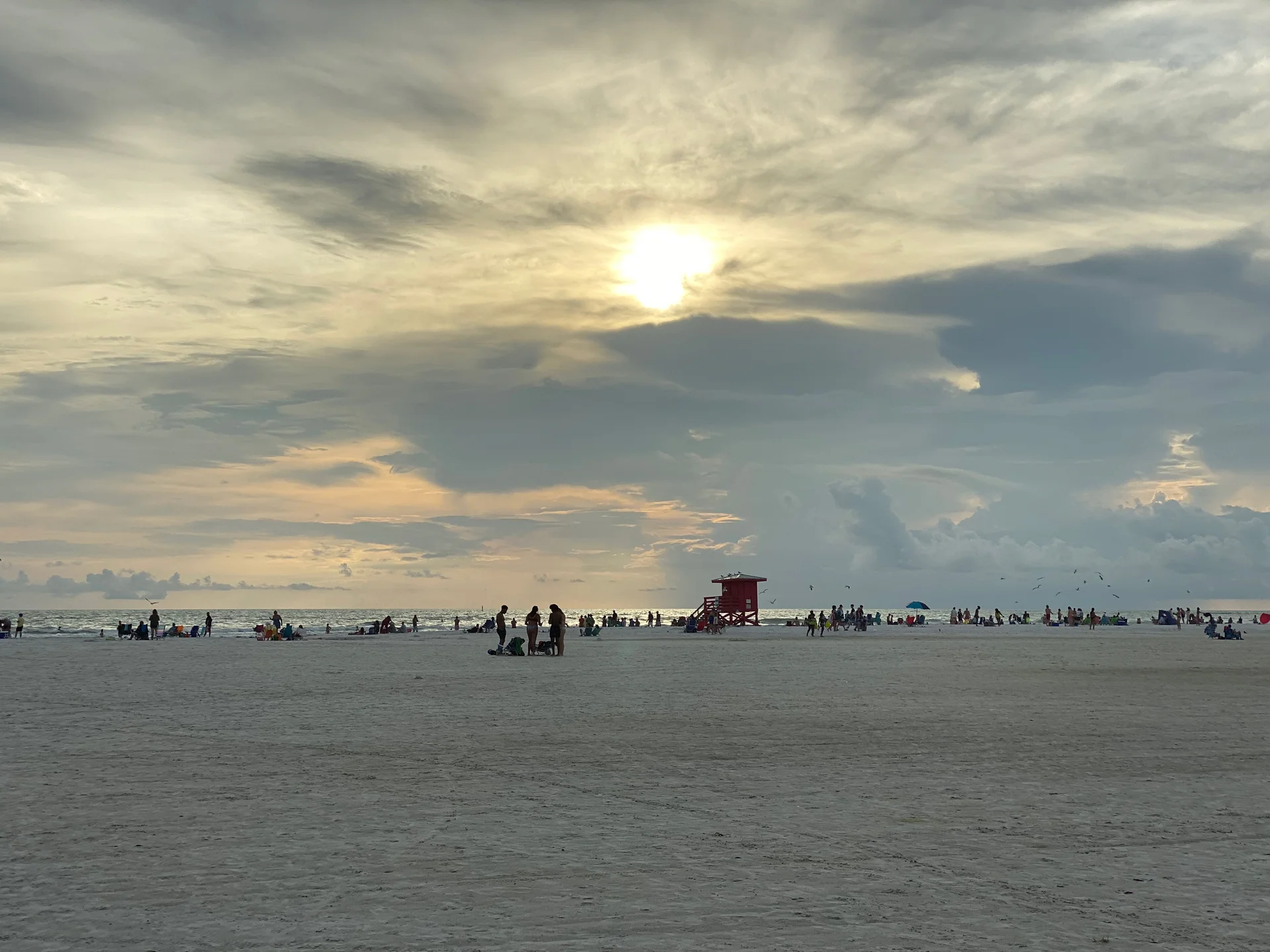
The widest section of the crescent beach, where low tide exposes several hundred yards of hard-packed quartz sand. Operated by Sarasota County Parks with approximately 970 free public parking spaces, lifeguard towers, shade pavilions, tennis/pickleball courts, and the Sunday evening sunset drum circle.
2. Crescent Beach & Point of Rocks (Beach Accesses 12 & 13)
Located south of Stickney Point Road, Crescent Beach shares the same fine white quartz sand as Siesta Beach but has only two public pedestrian accesses (Access 12 near Midnight Pass Road and Access 13 at Point of Rocks Road). At the southern tip, submerged Pleistocene limestone ledges create Point of Rocks—one of the best nearshore snorkeling spots in Sarasota County.
3. Turtle Beach Park (8918 Midnight Pass Rd)
At the southern end of the island, the shoreline steepens and the sand changes abruptly from white quartz to darker, shell-heavy sediment. Turtle Beach is favored by shell collectors, kayakers launching into Blind Pass Lagoon, and campers staying at the county-operated Turtle Beach Campground.
Numbered Beach Accesses & Breeze Trolley Strategy
Along Ocean Boulevard and Beach Road north of the main park, Sarasota County maintains numbered public pedestrian corridors (Beach Accesses 1 through 11). Accesses 2, 3, 4, 5, 7, 8, 9, 10, and 11 sit within walking distance of Siesta Key Village along Ocean Boulevard, though each access holds only 5 to 25 vehicle spaces.
When parking lots fill by 9:30 AM on weekends and winter afternoons, visitors can park in mainland connection lots or ride the free Siesta Key Breeze open-air trolley, which loops continuously between Siesta Key Village, Siesta Beach Park, Stickney Point Road, and Turtle Beach.